Role: Staff Product Designer
Domain: B2B Payments / Chargeback Management
Focus: Investigation UX, workflow efficiency, decision-making systems
Executive Summary
Redesigned the chargeback dispute response workflow from a template-driven, scroll-heavy UI into a guided, field-based workspace.
Removed guesswork around evidence requirements and validation.
Increased agent throughput from ~50 cases/day to nearly 80 cases/day.
Helped secure a major enterprise customer: Alaska Airlines.
The Problem
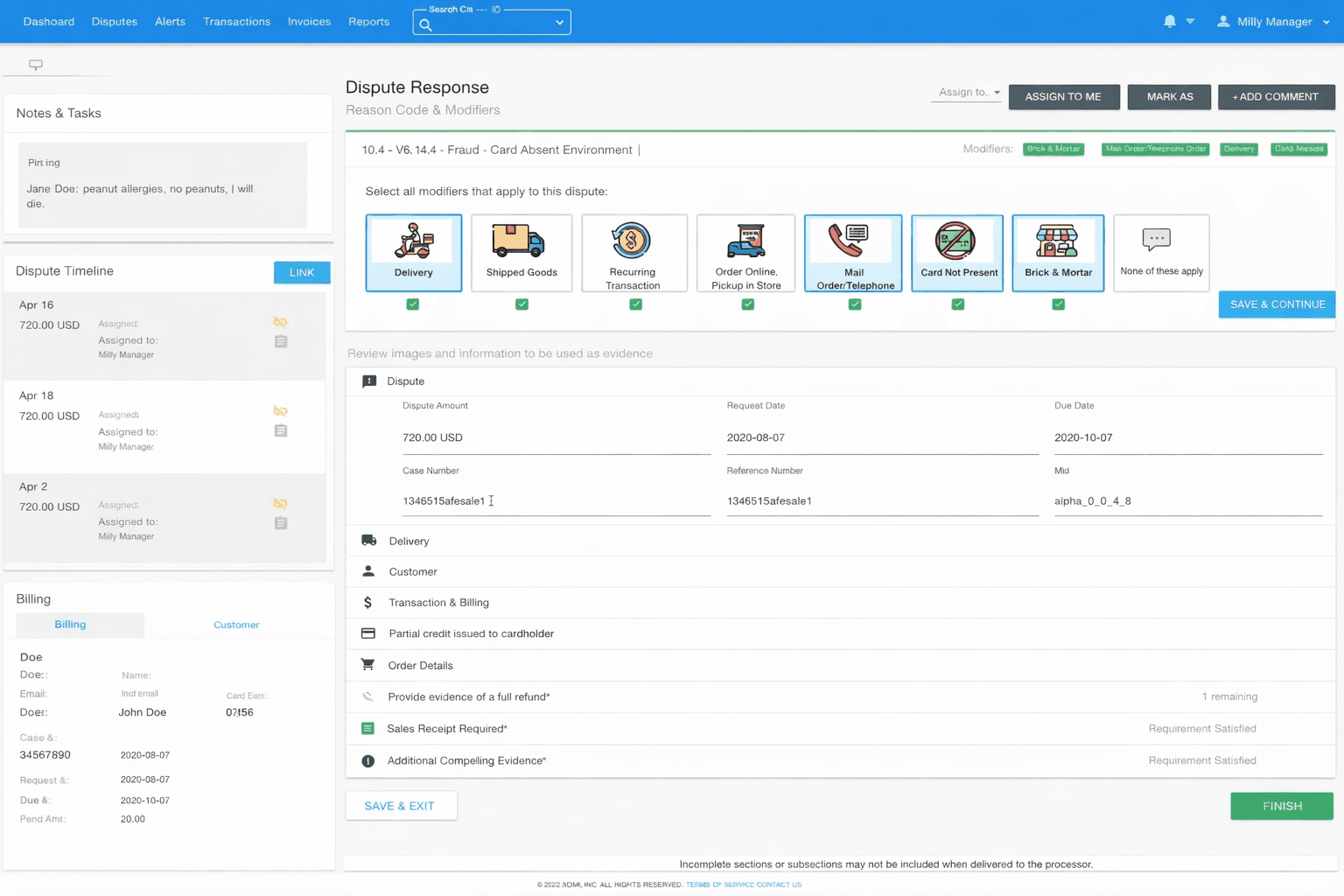
Agents handling chargebacks had to manually interpret templates, decide which evidence mattered, and verify completeness themselves.
Critical requirements were scattered across long pages, increasing cognitive load and slowing resolution.
Before (What Was Broken)
One long, scroll-heavy dispute response page.
Conditional sections with fragmented status feedback.
Templates existed, but:
Required vs optional fields were unclear.
Completion depended on agent experience.
High reliance on memory and tribal knowledge.
Result
Slower resolution.
Inconsistent dispute quality.
Hard to scale to enterprise volumes.
The Core Design Shift
I reframed the workflow from:
“Fill out a template and hope it’s complete”
👇🏻
“Complete a known set of required data fields and preview exactly what will be sent.”
What Was Shipped
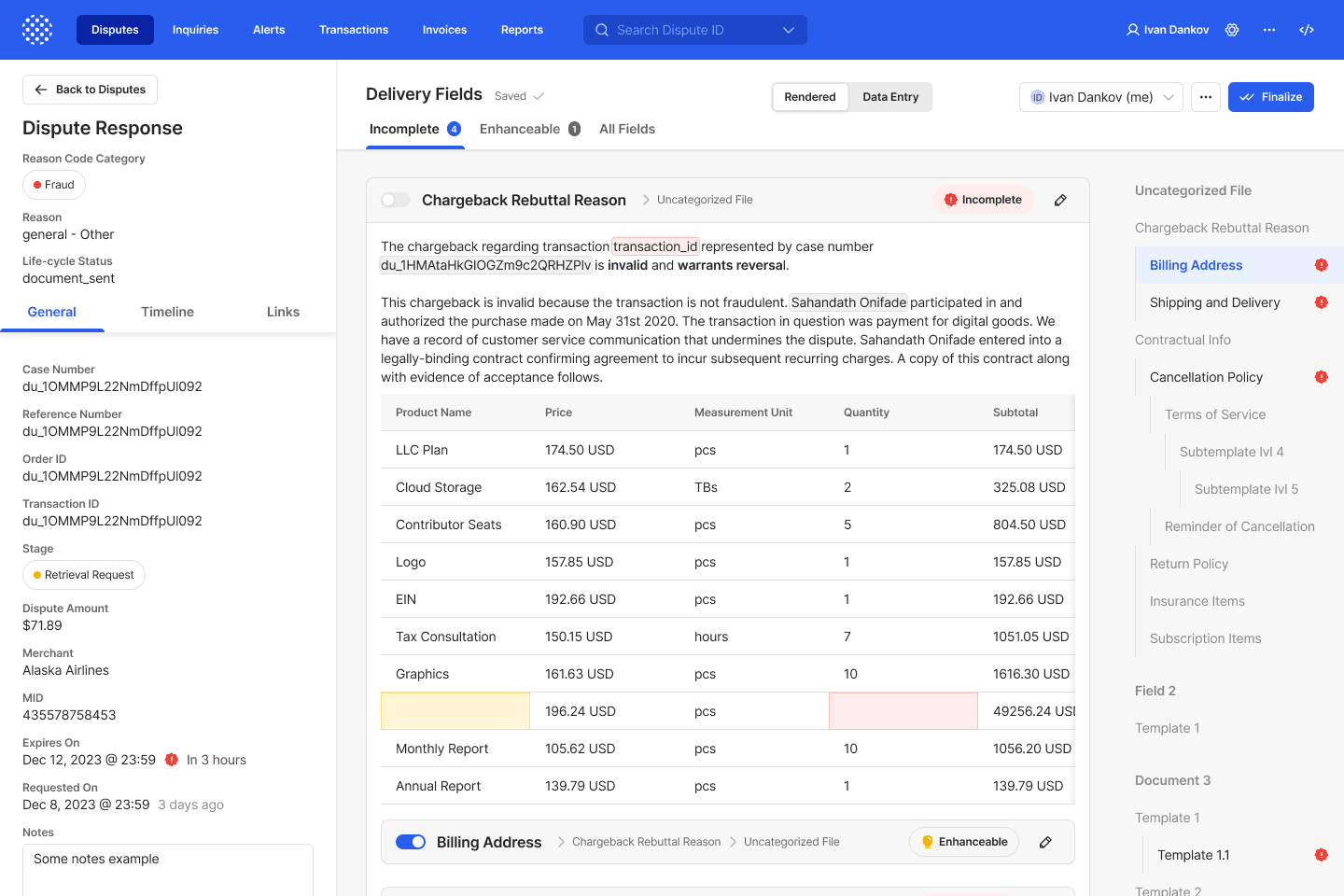
Field-Based Dispute Response
Broke templates into explicit, trackable data fields.
Each field has a clear state:
Incomplete
Enhanceable
Complete
Completion is deterministic and visible.
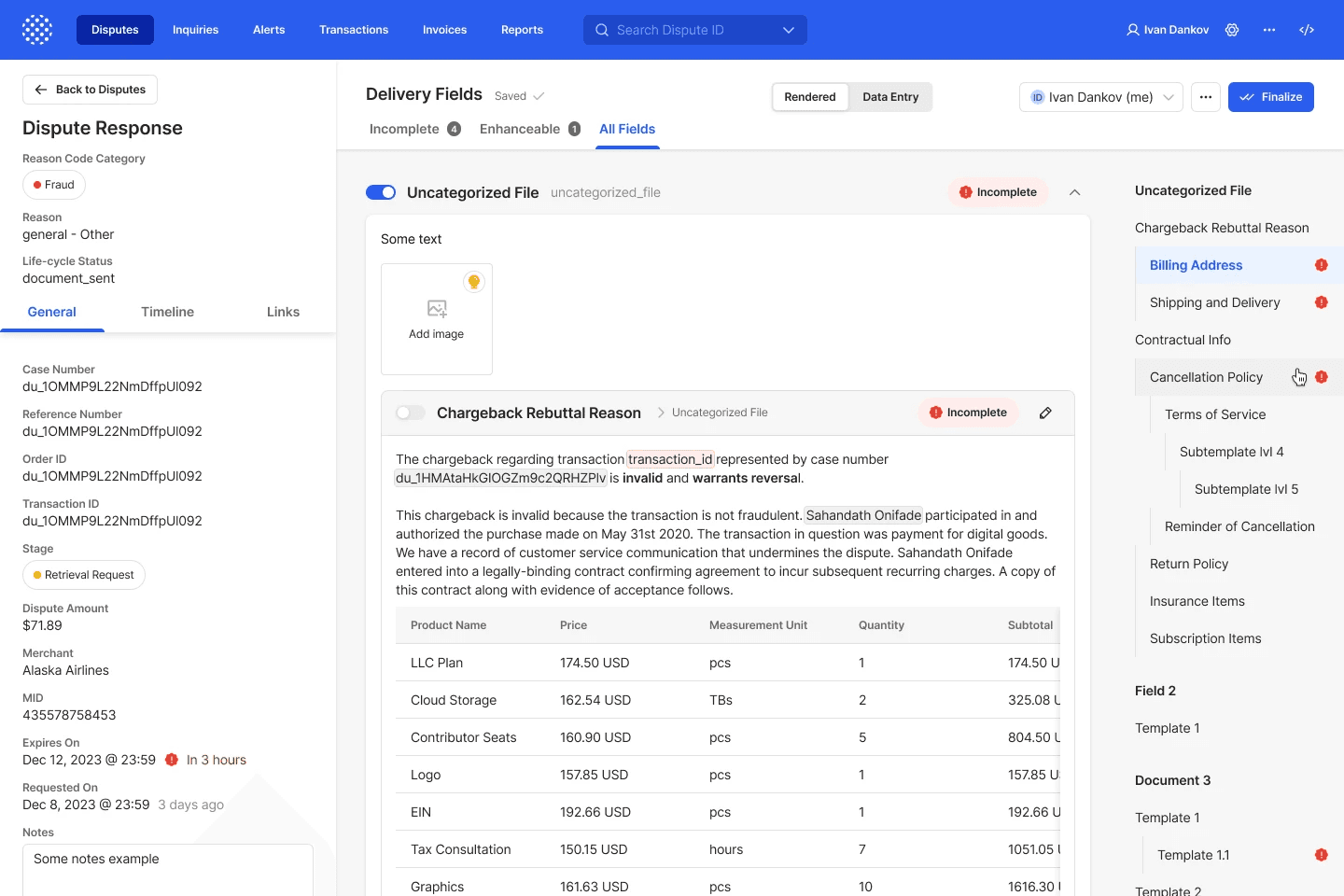
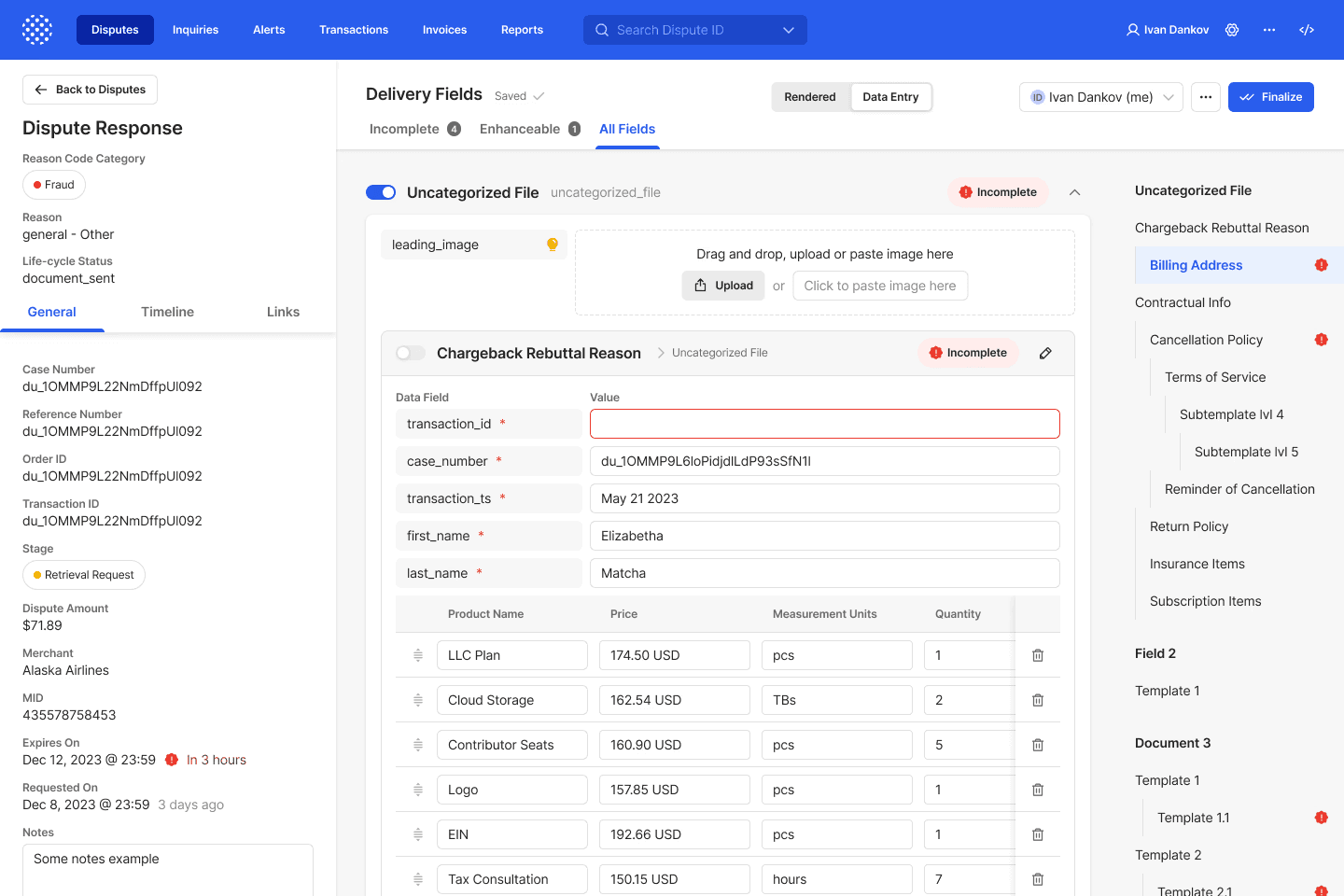
Rendered vs Data Entry Views
Data Entry view for structured input and validation.
Rendered view showing the final, human-readable chargeback response.
One source of truth, two representations.
Rendered view
Data entry view
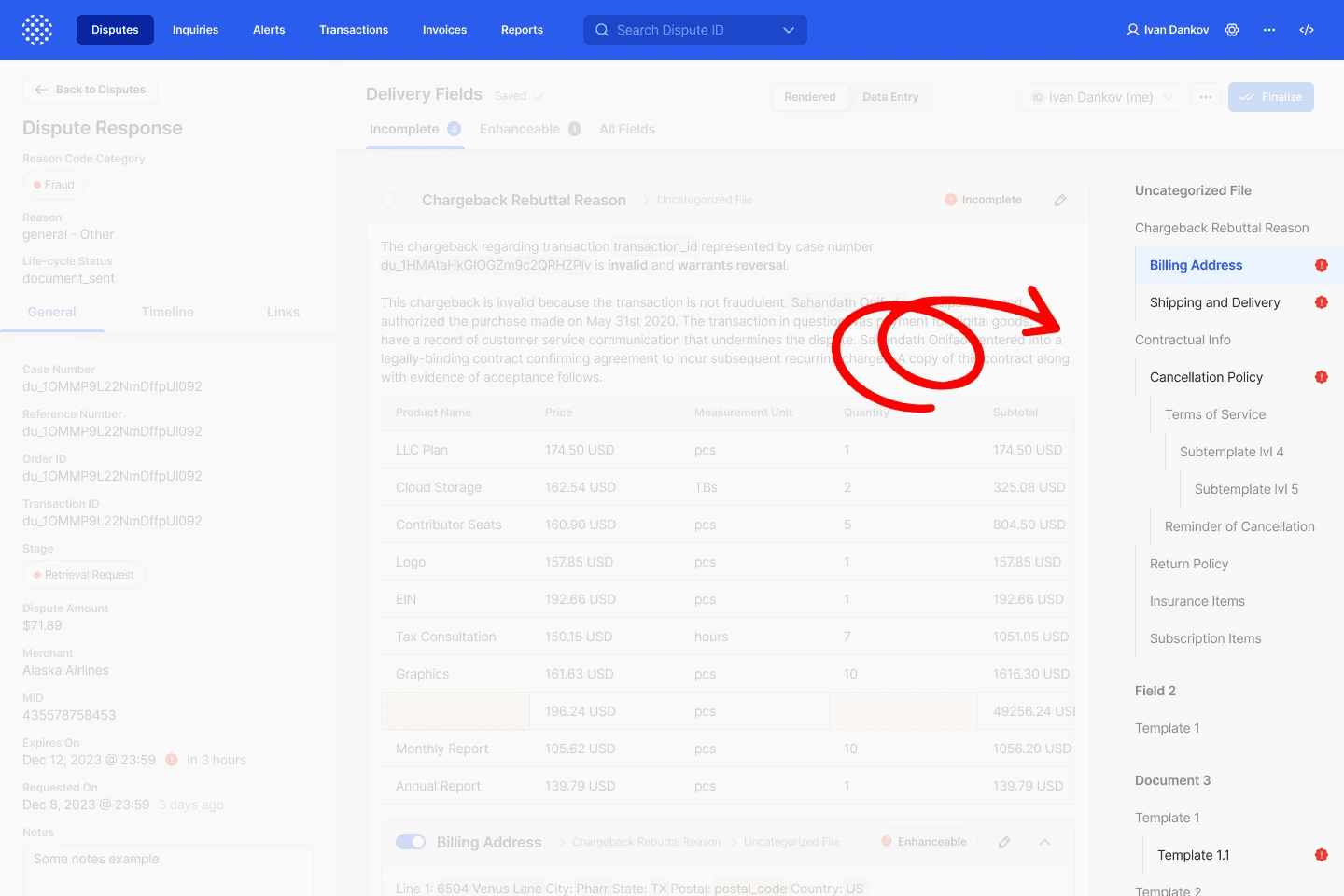
Guided Navigation and Validation
Right-side field navigator acts as:
Checklist
Progress indicator
Navigation aid
Inline validation surfaces missing or invalid fields immediately.
Agents always know what remains before submission.
Explicit Finalization Step
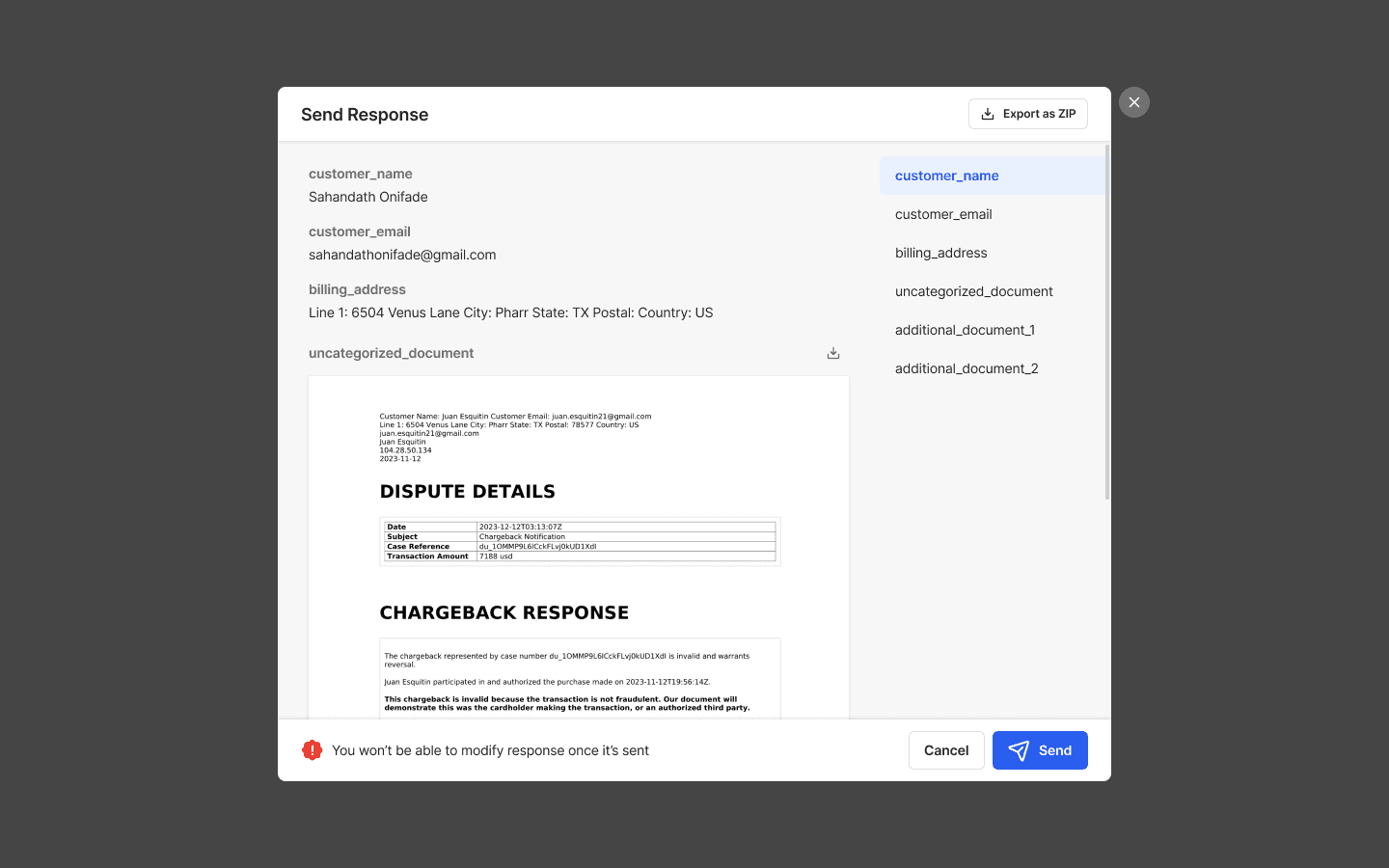
Separate “Send Response” modal with:
Full rendered preview
Included field list
Clear irreversibility warning
Prevents premature or incomplete submissions.
Impact
Operational
Agent throughput increased from ~50 cases/day to nearly 80 cases/day.
Reduced cognitive load and faster onboarding for new agents.
Business
The redesigned workflow helped close Alaska Airlines as a customer.
Demonstrated enterprise readiness and scalability.
Overcame Challenges
Solved a systemic workflow problem, not a UI polish task.
Re-architected how templates, data, and validation interact.
Balanced speed, accuracy, and compliance in a high-stakes domain.
Shipped measurable impact tied to both efficiency and revenue.
Trade-offs and Risks
More structure reduced free-form flexibility.
Required careful alignment with downstream processors.
Needed to preserve trust for existing power users.
These trade-offs were accepted to enable scale and consistency.
Next Steps
Auto-fill more fields from transaction data.
Add confidence scoring before finalization.
Surface processor-specific requirements earlier.